
How to apply role-playing constraints to AI for specialized task outputs

‘Act as a helpful assistant’ gets you a polite, generic reply, because that’s already the model’s default. To pull a real specialist voice out, you have to write the role with specifics that change vocabulary, sentence length, and what the model treats as obvious. The right adjectives aren’t decoration. They’re levers, and each one moves the writing in a measurable direction.
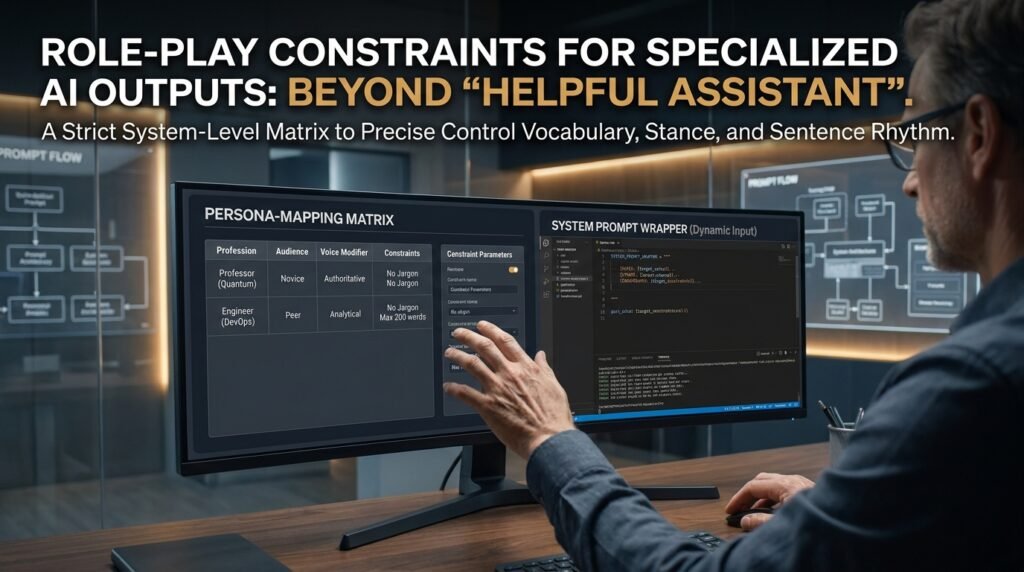
The persona-mapping matrix
Specific adjectives change specific things in the output. Vague ones don’t.
This is the part most prompt advice glosses over. ‘Professional’ adjusts almost nothing, since the model defaults to professional already. ‘Senior tax accountant explaining to a small business owner’ moves vocabulary, sentence length, and assumed knowledge all at once. Here’s how the levers map.
What you change | What it actually moves | Example |
Profession | Vocabulary and jargon level | ‘tax accountant’ vs ‘finance writer’ |
Years of experience | Confidence and qualifiers | ‘senior’ adds blunt opinions; ‘junior’ adds hedging |
The audience | Sentence length and assumed knowledge | ‘explaining to a 12-year-old’ uses short sentences |
Voice modifier | Tone and pace | ‘plainspoken’ shortens; ‘measured’ lengthens |
A named genre | Structure | ‘in a Q&A format’ restructures; ‘as a memo’ adds headers |
A constraint on style | Sentence rhythm | ‘no sentence over 20 words’ breaks up long ones |
A negative | What it stops doing | ‘no hedging’ removes ‘might/could/perhaps’ |
Combine three or four of these and you’ve described a real voice the model can copy. The trap is using only the first column. ‘Senior tax accountant’ alone doesn’t help much if you haven’t also said who the writing is for and how it should sound.
Read a real example, three ways

Same task, three different roles. The output reads as a different person each time.
Same question, three roles, three voices TASK: Explain why a small business should track inventory.
ROLE A (default): “You are a helpful assistant.” -> 4 paragraphs, polite, lists 5 generic benefits, hedges with ‘might’ and ‘could’ twice each.
ROLE B (specialist with audience): “You are a senior tax accountant explaining to a small business owner who has never tracked inventory. Plainspoken. No sentence over 18 words.” -> 2 short paragraphs, names two specific things (COGS, year-end write-offs), no hedging.
ROLE C (opinionated practitioner): “You are a bookkeeper with 20 years in retail. Blunt, no jargon, share what you wish your clients had done sooner.” -> 1 paragraph, leads with a strong opinion, names a specific mistake clients make. |
Role A is what most people start with and complain about. Role B and C don’t use cleverer prompting; they use the matrix above to move vocabulary, sentence length, and stance in deliberate directions.
The four parts of a usable role
A role that produces a specialized voice has four pieces, and each one does a different job.
- Identity. Profession plus one defining trait. ‘Senior tax accountant’ or ‘a bookkeeper with 20 years in retail.’
- Audience. Who is the writing for? An expert peer and a curious novice need very different sentences.
- Voice and pace. One or two style adjectives the model can act on: plainspoken, measured, blunt, warm. Skip the empty ones like ‘professional.’
- Constraints. Hard rules: a sentence-length cap, banned phrases, an output format. These keep the voice consistent across a long reply.
If a role you wrote isn’t working, the missing piece is almost always part 2 or part 4. The model can play a senior accountant; it can’t guess whether you want it to teach a 12-year-old or argue with an auditor unless you say so.
The adjectives that actually do work
Not all style words are equal. Some land, some don’t.
Word | What it does | Better alternative |
Professional | Almost nothing; it’s the default | Name a specific profession |
Engaging | Vague; adds filler enthusiasm | Concrete, specific, opinionated |
Friendly | Adds greetings and exclamation marks | Warm, no exclamation marks |
Concise | Often ignored on long answers | No sentence over 20 words |
Authoritative | Adds confident-sounding generalities | Blunt; share what you’d tell a friend |
Casual | Drops contractions in; otherwise vague | Plainspoken; one contraction per paragraph |
Conversational | Adds ‘hey there’ openers | Like explaining to a smart colleague |
The pattern is the same in every row. Vague adjectives produce vague results; concrete instructions, especially with a measurable rule like a sentence cap, produce predictable shifts in the writing.
Hard constraints lock the voice in place
Adjectives suggest. Constraints enforce.
On a one-paragraph answer, a vibe instruction often holds. On anything longer, the model drifts back toward its default. Hard constraints, the kind you can check after the fact, hold the voice all the way through. The three I rely on: a sentence-length cap, a banned-phrases list, and an output shape. A sentence cap of about 20 words forces a punchier rhythm. A banned-phrases list removes the model’s most overused tells, the wrap-up cliches and the ‘as an AI language model’ opener. An output shape, like ‘three short paragraphs, no headers,’ stops the model from defaulting to its favorite five-section memo.
Negative instructions matter as much as positive ones
Telling the model what not to do is half the role.
Most generic-sounding output comes from a handful of habits the model has learned: hedging with ‘might’ and ‘could,’ opening with ‘great question,’ wrapping up by restating what it just said, dropping in three-item lists when one would do. A ‘no’ list in your prompt removes these directly, where a positive instruction often doesn’t catch them. ‘Be confident’ rarely stops the hedging; ‘no use of might, could, perhaps, or sometimes’ does. Pair every positive trait with the bad habit it should replace, and the role holds together.
The few-shot trick when adjectives aren't enough
When a voice still drifts, give the model a sample of the voice instead of describing it.
Paste one or two short examples of writing in the exact style you want, right inside the role, and tell the model to match the voice. This is more reliable than any list of adjectives for capturing a real person’s rhythm, because the model copies what it sees better than it interprets what it’s told. Two samples is plenty; ten just muddies the picture. The samples don’t have to be on the same topic as the task; they just have to demonstrate the voice.
Two real samples, one role You are a senior tax accountant. Match the voice in these two samples:
Sample 1: “You don’t need a full ledger from day one. Start with two columns: money in, money out. Add the rest when the IRS asks for it.”
Sample 2: “The mistake I see most is treating receipts like souvenirs. They’re evidence. Photograph them, file them in a folder by month, move on.”
Now answer the task in the user message in that voice. |
What to ask for, by task
Different tasks pull for different roles. A short cheatsheet.
Task | Useful role to try | Constraint that usually helps |
Internal memo | Manager who hates meetings | No filler; lead with the ask |
Customer reply | A specific senior support rep | Match this voice (paste 2 past replies) |
Technical explainer | Engineer explaining to a non-engineer | No analogies that don’t land in 1 line |
Sales draft | Quiet, evidence-led seller | No superlatives, no exclamation marks |
Critique of writing | Skeptical editor reading aloud | Mark every claim that needs a source |
Brainstorm | A weird, contrarian peer | Half the ideas must be uncomfortable |
Stacking roles: when one specialist isn't enough
Two well-chosen roles in sequence often beat a single perfect one.
Some tasks have two distinct jobs inside them. Writing a customer reply about a refund is both a support-rep task (tone, empathy) and an accounting task (what’s allowed, what isn’t). One role tends to do one of these well and the other poorly. The fix is to chain: ask the senior accountant role to draft the policy-specific content first, then ask the support-rep role to rewrite that draft in the customer voice without changing the facts. Each step has one job, each role does what it’s good at, and the output is better than any single combined role could produce. The pattern works anywhere two professions naturally collaborate on a real task.
Testing whether the role is doing anything
Half the roles people write change nothing. The two-prompt test catches it.
Run the task with your role in place, save the output. Run the same task with no role at all, just the bare instruction. If the two outputs read the same, your role is decoration, not direction. If only a few words differ, it’s barely moving the dial. A role earns its place when you can point at specific differences in vocabulary, sentence length, or stance, and trace them back to the words in your role. This is the test most prompt advice skips, and it’s the one that tells you which adjectives are doing real work and which are just there for comfort.
Where roles don't help
Roles are a voice tool, not a magic upgrade.
A persona can’t make the model know facts it doesn’t, and ‘act as a doctor’ won’t make a medical answer any more accurate. The model is still the model; the role just changes how it talks. For factual tasks where the content matters more than the voice, ground the prompt in real source material and treat the role as a wrapper around that. Roles do their best work on writing tasks, where tone and structure are most of the value, and on tasks where you’d otherwise spend ten minutes editing the model’s default tone out anyway.
Questions people actually ask
Will a role make the model less accurate?
Usually no, and sometimes yes. A specialist role often produces more useful answers because it discards generic hedging. An over-the-top role (‘act as the world’s leading expert’) sometimes makes the model assert things more confidently than it should. Keep the role real, and verify the facts the same way you would without one.
How long should the role be?
Short enough to scan: a sentence or two for the identity and audience, a line for voice, a line for constraints, and a couple of samples if you have them. Past about 200 words, you’re piling on noise that competes with the actual task. The four parts above are the structure; the rest is restraint.
Can I keep the same role across many chats?
Yes, and you should for any role you reuse. Save it in your custom instructions or project settings so every new chat starts with it loaded. Keep separate saved roles for separate kinds of work, since one generalist role tends to underperform two specialized ones.
My role works on short tasks and fails on long ones. Why?
Drift. The model leans back toward its default as a reply gets longer, especially past several hundred words. The fix is harder constraints, a sentence cap and a banned-phrases list, that stay enforceable even at length. If a role won’t hold for two pages, it was carried by vibe rather than rules.
Should the role explain why it’s that persona?
No. A role is for the model to act on, not to philosophize about. ‘You are a senior accountant’ is plenty; ‘You are a senior accountant because the user needs financial clarity’ adds noise and sometimes makes the model self-reference its own role mid-answer. State the persona, give it the rules, and stop.
Is there a difference between ‘system prompt’ and a role in the chat?
Mostly stability. A role in the system or custom-instructions layer applies to every new chat and persists. A role typed into the chat box applies only to that conversation and can fade as the chat gets long. For a role you use daily, the system layer is the right home; for one-off experiments, the chat box is fine.
Write the role you wish a colleague had handed you
Open your next prompt and replace ‘act as a helpful assistant’ with a four-part role: a specific identity, the audience, two voice words, and a hard constraint. Add two short samples of the voice if you have them. Run it on a real task, and notice where the output still sounds generic; that’s where the next constraint goes. After a few iterations, you’ll have a role that produces a specialist’s voice on demand instead of a polite stranger’s.

Hi I’m Muzammil Haqani. I’m a content creator and AI expert with 3+ years of experience exploring and writing about artificial intelligence and technology. Through this blog, I share tutorials, insights, and practical guides to help readers understand and use AI tools effectively in their everyday lives.